Heart attack happens when blood flow to heart is suddenly reduced or cut off or stops to part of heart as it carries oxygen to heart. During heart attack, heart muscle doesn’t get oxygen it needs. Without oxygen, muscle can be damaged or destroyed. Getting blood flow restored quickly is key to recovery. Get medical aide right away if you think you’re having symptoms of heart attack.
Doctors divide heart failure cases into four levels of increasing severity:
a: Physical activity is unaffected, and patient has no unusual fatigue, shortness of breath, palpitations, or pain during normal activities.
b: Slight limitations on normal activities as patient may experience mild fatigue, shortness of breath, palpitations, or pain during normal activities; no symptoms at rest.
c: Marked limitation on normal activities as patient experiences fatigue, shortness of breath, palpitations, or pain during less than normal activities at same time no symptoms at rest.
d: Patient is uncomfortable even at rest and discomfort increases with any physical activity.
Doctors also classify heart failure according to whether it is primarily a problem of pumping blood out of heart due to a weakened heart muscle, or if patient has problems primarily with filling heart due to a stiff heart muscle (also called heart failure with normal ejection fraction). Heart failure with normal ejection fraction now accounts for almost half of heart failure and is dominant type of heart failure seen in elderly. Contrary to its name, congestive heart failure does not mean heart has failed completely.
It means heart is pumping inefficiently and no longer can meet body’s need for blood. This inefficient pumping causes a backup of blood in veins leading to heart and causes kidney to retain fluid as a result body’s tissues swell. Swelling (edema) most commonly affects legs, but can also occur in lungs, causing breathing difficulty, and in other tissues and organs.
CAUSES of heart failure are:
•Coronary artery disease (narrowing or hardening of arteries that supply blood to heart muscle, usually caused by a buildup of fats and cholesterol)
•Cardiac arrhythmias (problems with heart rate and/or rhythm)
•Chronic kidney disease
•Diabetes mellitus, Hyperthyroidism, and chronic (long-lasting) lung disease also increase risk of congestive heart failure
•Dysfunction of heart muscle (cardiomyopathy)
•Dyslipidemia/ high levels blood cholesterol (abnormal levels of lipoproteins in blood), particularly high low-density lipoprotein, low high-density lipoprotein, high triglycerides and obesity
•Exposure to toxins, including excessive alcohol
•Heart defects present at birth
•High blood pressure (hypertension)
•Infection of heart valves or muscle (endocarditis or myocarditis)
•Many patients with heart failure have both coronary artery disease and hypertension
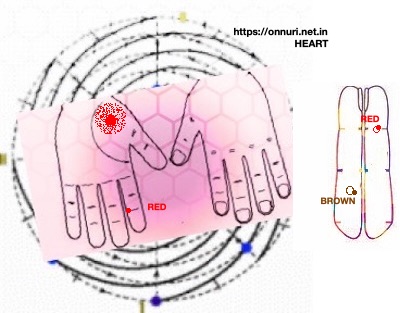
In some people with congestive heart failure, heart muscles become weaker and cannot pump as well. In other, muscles become stiff, and heart cannot fill with enough blood between heartbeats. A buildup of cholesterol and fatty material called plaque in artery walls usually causes heart attack. The buildup of plaque normally takes years. Most heart attacks happen when plaque breaks off artery wall. A blood clot then forms around broken-off plaque, blocking artery.
To counteract depression of cardiovascular system in patients, ONNURI may bring some sort of sprouting outcome. There appears little sensitivity to needles, but often once micro needles are in place, most people relax and even fall asleep for treatment that has a positive and holistic effect. Aim is to promote health and ease sufferings. Give a Try! In meantime, one may start pull-push exercise through thumb itself on the mount of palm as per marking plus to mark colors as prescribed with marker pen only and put any seed to pulsate it, preferably with white pepper seed!
https://onnuri.net.in ‘Dr Dinesh kapur’
 ONNURI
Believe in Cure!