Spasticity is involving hypertonia, a general treatment guideline can be followed that involves:
•Initial focus on first activating contraction of antagonist muscles to provide reciprocal inhibition and lengthen spastic muscles
•Reciprocal actions are attempted. Agonist contractions are performed first in small ranges progressing to larger arcs of movement
•Highly stressful activities be minimized early in training
•Functional skills are targeted for training
•Patients and family /caregivers should be educated about importance of maintaining range of motion and doing daily exercises
•Occupational therapy regimens of assisted stretching, strengthening, functional tasks, and /or targeted physical activity and exercise are usually the chief ways to keep spastic CP well-managed, although if the spasticity is too much for the person to handle, other remedies may be considered.
SPASTIC is another term of cerebral palsy wherein spasticity is either dominant or exclusive impairment present. Movement disorders is broad terms that refer to several conditions where the neurons that are responsible for voluntary movement are impaired. Affected person seems to be hypertonic called neuromuscular mobility impairment, rather than hypotonia or paralysis, also referred to as an unusual “tightness”, stiffness, and or “pull” of muscles, where a lack of inhibition results in excessive contraction of the muscles, ultimately leading to hyperflexion (overly flexed joints). Though spastic cerebral palsy is often designated by body topography. Although it has its origins in a brain injury, but largely be thought of as a collection of neuromuscular issues because of how it manifests symptomatically over the course of the persons’ lifespan. It mostly occurs in disorders of the central nervous system (CNS) impacting upper motor neuron in the form of lesion, such as spastic diplegia but it can also present in various types of multiple sclerosis, where it occurs as a symptom of the progressively-worsening attacks on myelin sheaths and is thus unrelated to the types of spasticity present in neuromuscular cerebral palsy rooted spasticity disorders.
Spastic hemiplegia is one side being affected. Generally, injury to muscle-nerves controlled by the brain’s left side will cause a right body deficit, and vice versa, such people generally have a limping instability on the affected side and are primarily prescribed ankle foot orthoses.
Spastic diplegia is lower extremities affected, with little to no upper-body spasticity. The most common form of spastic forms, most people with spastic diplegia are fully ambulatory but are “tight” and have a scissors gait. Flexed knees and hips to varying degrees, and moderate to severe adduction (stemming from tight adductor muscles and comparatively weak), are present. Gait analysis is often done in early life on a semi-regular basis. In addition, these individuals are often nearsighted. Over time, the effects of the spasticity sometimes produce hip problems and dislocations, also crossed eyes can be present as well.
•Spastic monoplegia is one single limb being affected.
•Spastic triplegia is three limbs being affected.
•Spastic quadriplegia is all four limbs equally affected. People with spastic quadriplegia are least likely to be able to walk, or if they can, to desire to walk, because their muscles are too tight, and it is too much of an effort to do so. Some children with spastic quadriplegia also have hemi paretic tremors; an uncontrollable shaking that affects limbs on one side of body and impairs normal movements.
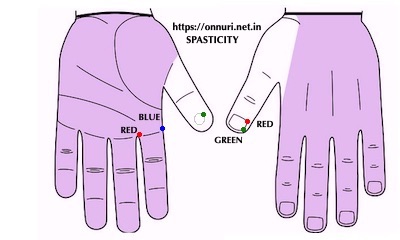
Prevention of brain damage before, during, and soon after the birth is most important way of curing cerebral palsy.
Though, with the energy concept of ACUPUNCTURE, including colors that can move and reach up-to any extent in core areas. It aids in strengthening the immune system and serves to prevent diseases, control pain and increase both the ability to act and the quality of affected persons live. In any case wind energy is necessary to activate movement through energy pathways for better results! It has helped many people who were not successfully treated through conventional western medicine.
https://onnuri.net.in ‘Dr Dinesh Kapur’
 ONNURI
Believe in Cure!