An eye disorder that gradually degenerate the vision acuity. At early stage there is only blurring of vision, but later stages the possibility of eyesight lost. It’s a unique window into health. It is the only place in the body where, without surgery, we can look in and see veins, arteries and a nerve [the optic nerve]. The eyes’ transparency explains why common eye diseases such as glaucoma, cataracts and macular degeneration can be detected early with regular eye exams. The Symptoms of optic atrophy are a change in optic disc and a decrease in visual function. This change in visual function may decrease in sharpness and clarity of vision (visual acuity) or decreases in side (peripheral) vision. Color vision and contrast sensitivity can also be affected.
The causes may range from trauma to systemic disorders, tissue death of the nerve that carries the information about sight from the eye to brain.
Pathogenesis-Differentiation;
•Deficiency of kidney and liver leads to consumption of essence and blood that nourish the eyes.
Main manifestations: Dryness of eyes, blurred vision, dizziness, tinnitus, nocturnal emission, aching of the lower back, thready and weak pulse, reddened tongue with scanty coating.
Analysis: Dryness of eyes and blurred vision are due to failure of essential nutrients to nourish the eyes in deficiency of liver and kidney. The limbus is the seat of kidney. When kidney is in a deficiency state, there is aching of lower back. Deficiency of kidney may lead to nocturnal emission when there is hyperactivity of asthenic fire and to dizziness and tinnitus when there is yang preponderance. Thready and weak pulse, reddened tongue with scanty coating is a sign of yin deficiency.
•Dysfunction in transportation and transformation of spleen due to irregular diet and over strain results in inadequate supply of essential nutrients for the eyes.
Main manifestations: Blurred vision, weakness of breathes, disinclination to talk, lassitude, poor appetite, loose stools, thready and weak pulse, and pale tongue with thin white coating.
Analysis: The essential qi of all zang-fu organs flows up to the eyes. When qi and blood in a deficiency state cannot nourish the eyes, the vision becomes blurred. Qi deficiency of the spleen and stomach causes weakness of breath, disinclination to talk, lassitude, poor appetite and loose stools. Thready and weak pulses, pale tongue with thin and white coating are signs of deficiency of qi and blood.
•Dysfunction of liver with stagnation of qi and blood in emotional troubles causes failure of essential qi to flow upwards to nourish the eyes.
Main manifestations: Blurred vision, emotional depression, dizziness, vertigo, hypochondriac pain, and bitter taste in the mouth, dry throat and string-taut pulse.
Analysis: The liver has its specific body opening in eyes. Stagnation of liver qi causes general obstruction of qi and blood that fail to ascend to nourish eyes so the blurred vision. The Liver meridian passes by hypochondriac region, so there is hypochondriac pain when the liver qi is stagnated. Retarded qi may turn into fire, which flares up to cause dizziness, vertigo, bitter taste in mouth and dry throat. String-taut pulse is the sign of a liver disease.
But blurred vision in diabetic means: Diabetics are at increased risk for several eye problems, including glaucoma and cataracts. But the most common threat to vision is diabetic retinopathy, where diabetes affects the circulatory system of eye. It is leading cause of blindness. The changes linked to diabetic retinopathy tend to show up in people who have had the disease for a long time, not those recently diagnosed. The person may also see “floaters,” tiny dark specks in the field of vision. Sometimes diabetes causes small hemorrhages (bleeding) that are visible in the eye. There’s no pain. People with poorly controlled blood sugar may have worse symptoms. Someone with diabetes should have a dilated eye exam annually to catch and control the earliest stages of retinopathy, glaucoma, cataracts or other changes—before they manifest as changes you’re aware of.
There are other unrelated causes of optic atrophy is poor blood flow, called ischemic optic neuropathy, which most often affects elderly. Shock, various toxic substances, radiation, and trauma can also damage the optic nerve. Various eye diseases, most commonly glaucoma, can also cause optic nerve atrophy. In addition, diseases of brain and central nervous system, such as cranial arteries sometimes called temporal arteries, multiple sclerosis, brain tumor, and stroke, can cause the condition.
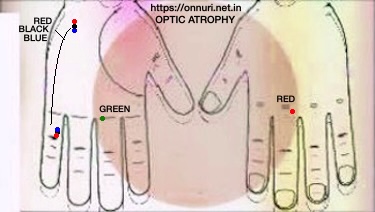
One should apply to reinforce the liver and kidney and nourish qi, blood by tonifying method. Even movement is applied to the same meridian to remove stagnation of the liver qi.
Energy Acupuncture ~ an important aspect of concept is that it allows considering an individual characteristic manifested in own energy constitution. This brings about an effective action on the very origin of disease. Besides, there are practically no contradictions for use of ONNURI. It’s a traditionally accomplished through insertion of very fine needles at the certain energy meridians in miniature form of body only on the palm. The course of treatment is definitely sprouts the outcome! Meanwhile, may put color dots with permanent marker pen to aide in syndrome!
https://onnuri.net.in ‘Dr Dinesh kapur’
 ONNURI
Believe in Cure!